The Living Word Series · Book Three
In October 1965, a Columbia University psychologist began hearing a voice that identified itself as Jesus of Nazareth. What emerged over seven years was not a new religion but a correction — the same grace Paul glimpsed on the Damascus Road, without the sacrificial scaffolding. The same love the Gospels proclaimed, without the wounded God the councils constructed.
The Living Word series has been building toward a single question: is the grace Paul experienced on the road to Damascus actually available? Not available in theory, through the mechanism of a sacrifice. Actually available — now, without condition, without payment, without the weight of a framework that partially obscures what it was built to explain?
A Course in Miracles answers that question directly. It was not written as a response to Paul or to the councils, but it addresses, with remarkable precision, exactly the distortions this series has been tracing. The atonement does not require a sacrifice — it requires only the correction of the belief that separation from God was ever real. The body is not the enemy of the spirit — it is a neutral instrument in the hands of the mind that guides it. The God who required appeasement before love could be extended is not the God who is Love. And love, as the Course states without qualification, is all there is.
This book presents A Course in Miracles not as a replacement for Christianity but as its completion — the resolution of tensions that Paul could not fully resolve with the conceptual tools available to him, and that the councils resolved in ways that created new ones. The voice that spoke to Helen Schucman in 1965 is, in the Course's own claim, the same voice that spoke in Galilee. This book takes that claim seriously and examines what it means for everyone who has loved the Christian faith and found, at some point, that it did not fully hold them.
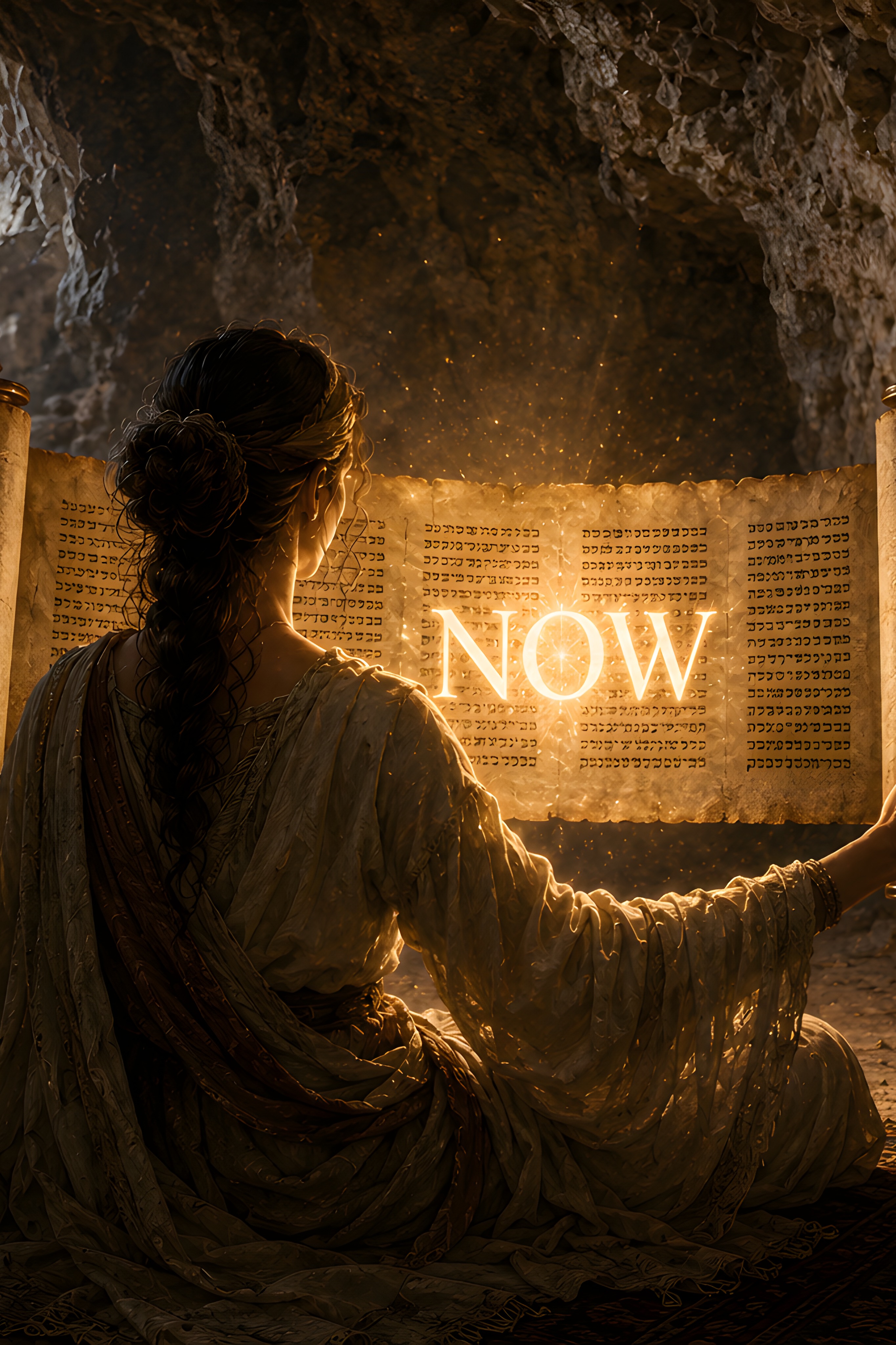
Before the dictation began, Helen Schucman had a series of dreams. In one of them she found herself holding an ancient scroll. The scroll extended to the left — into the past — and to the right — into the future. At its center was a single word, luminous and still: NOW.
She was invited to open the scroll in either direction. She stayed in the center. In the dream, she was told she had chosen correctly.
"The past is over. It can touch me not. I am the holy Son of God Himself, and I would look upon the face of Christ this very day, and come home."
A Course in Miracles, Workbook Lesson 239The Course's teaching on time is among its most radical departures from conventional Christian theology — and its most direct response to the weight of history this series has been tracing. The past of Paul's framework, the past of the councils' decisions, the accumulated distortions of twenty centuries, can be set down. Not by ignoring them, but by recognizing that the present moment — the now — is where the correction is always available, where the voice is always speaking, where grace requires no historical mechanism to be real.
The question the book is written to address: for the person who believes in grace and cannot quite receive it.
How A Course in Miracles came: Helen Schucman, the scribing, and the urgency behind the dictation.
The relationship between the Course and the Gospels. Two documents. One voice.
The Course as path and community. Self-study, study groups, and the resources available to new students.
What the New Testament actually says about God, and what the councils constructed. The gap between them.
The Course's foundational psychology: the ego not as Freud's mediator but as the belief in separation itself.
The difference between conventional forgiveness and the Course's understanding. Why it is the curriculum's center.
Penal substitution examined fairly and corrected precisely. No payment was ever required.
The Course's account of the Holy Spirit as the answer to the separation — and its relationship to Jesus's promise in John's Gospel.
Paul's eschatology, Augustine's delay, and the Course's redefinition: not a future event but a present awakening.
What the Course teaches about death, continuity, and the reality that outlasts the body.
What the Course actually is and how to begin. A little willingness. The final word — in Jesus's own voice.
Available now in eBook. Paperback edition arriving shortly.
The Living Word is a three-book series organized around a single question that every serious reader of the New Testament eventually faces: how did the message become the institution? How did the Way become Christianity? And what does it mean for the faith lives of actual people today that it did?
Paul, the Architect of Christianity enters that question through the life of the man who did more than any other to shape what the Jesus movement became: a man of extraordinary intelligence and genuine devotion who built something that neither he nor Jesus fully intended, and who spent his life wrestling with the gap between what he taught and what he could not yet receive.
Jesus, Then and Now: From Paul to A Course in Miracles follows the theological thread from Paul’s framework across twenty centuries to its twentieth-century resolution. It asks what Paul got right, what he left unresolved, and how A Course in Miracles addresses precisely the fault lines his framework opened.
Jesus Speaks Again, the concluding volume, presents A Course in Miracles not as a replacement for Christianity but as a correction issued by the same voice that began the conversation in Galilee, twenty centuries later, when the distortions had accumulated to a point that required a direct response.
The series is written for the person who believes in grace and cannot quite receive it. For the person who knows, somewhere, that God is love, and keeps encountering a version of God that does not feel entirely loving. The Way is not lost. It has simply been waiting, with characteristic patience, for anyone willing to look at it again.
Book One: Paul, the Architect of Christianity
Book Two: Jesus, Then and Now: From Paul to A Course in Miracles
Book Three: Jesus Speaks Again